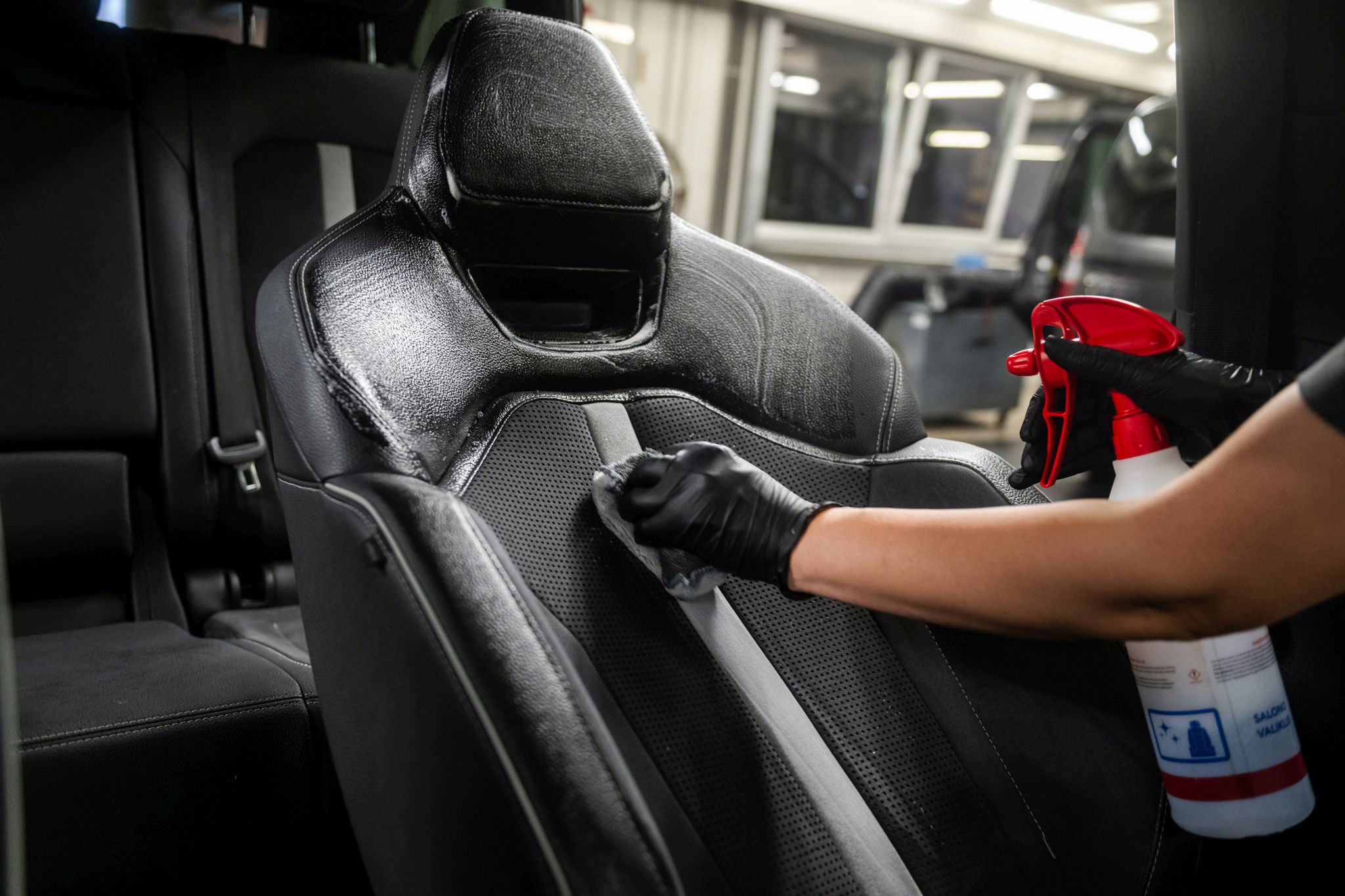
Many drivers try to remove stains from their car seats as soon as they notice them. However, dirt often hides in places like under child seats — and can stay there for months. Does that mean restoring cleanliness is no longer possible?
Once you spot a stain, it’s important to act quickly.
Stains inside a car can appear for many reasons, but most would agree they usually happen when we eat or drink on the go. If you notice a stain right away, it’s best to take action immediately.
For example, if you spill coffee or a colored soft drink, the first thing you should do is dilute the stain generously with water. This helps prevent too much pigment from soaking into the material and makes the final stain removal easier.
Old, set-in stains can be a tougher challenge that requires more effort and the right products. However, that doesn’t mean it’s impossible to restore the original look.
“It all depends on the material your car seats are made of and what caused the stain,” explains Algirdas Plečkaitis, head of the car cleaning centers Hocus. “Some stains come out more easily from light-colored interiors, others from dark ones. Leather surfaces are generally the easiest to clean—except for perforated or suede leather. If the source of the stain contains a lot of pigment, the longer it stays, the harder it is to remove. However, with the right products and enough time, even these stains can be completely cleaned.”
A professional deep cleaning can take anywhere from 2 to 6 hours, sometimes even longer, depending on the cause of the problem and the type of surface being cleaned. For instance, if a liquid drink spills onto fabric upholstery and soaks into the deeper layers of the seat — such as the foam padding — the process takes more time. More water and cleaning agents are needed to draw the dirt out to the surface and remove it completely. If only the top layer is cleaned, the stain will eventually reappear as the deeply absorbed dirt starts to rise back up.
Which types of stains are the hardest to remove?
Not all stains are created equal, as the difficulty of removal depends on several factors. Liquid spills tend to penetrate deeper, while thicker substances usually remain on the surface, making them easier to clean. However, even in these cases, other conditions come into play. For example, if you don’t clean a sauce spill immediately—or don’t do it thoroughly—the stain can set deeply into the fabric, like in the fibers or seams. In such cases, the stain will need to be moistened and treated with cleaning agents to soften and lift the substance from the surface.
Not all thick or solid substances are necessarily easier to remove than liquids. Thick, sticky items like honey, chocolate, caramel, or other sugary and sweetened substances are particularly clingy, making them not only harder to clean but also prone to attracting more dirt. However, the most difficult of all to remove is chewing gum.
“Chewing gum presents extra challenges because it’s very sticky and can easily embed itself into fabrics. It usually ends up in cars on our shoes, right on the floor mats. In such cases, several cleaning methods are needed. First, as much of it as possible is removed mechanically, and any remaining residue is treated with special solvents. But with the right products and a good dose of patience, even this stubborn ‘sticker’ can be completely removed,” assures A. Plečkaitis.
Experts emphasize that leather surfaces require extra care. After cleaning and drying, they must be treated with special leather conditioners. This prevents the leather from drying out and cracking, and also makes it easier to remove any new dirt that appears.